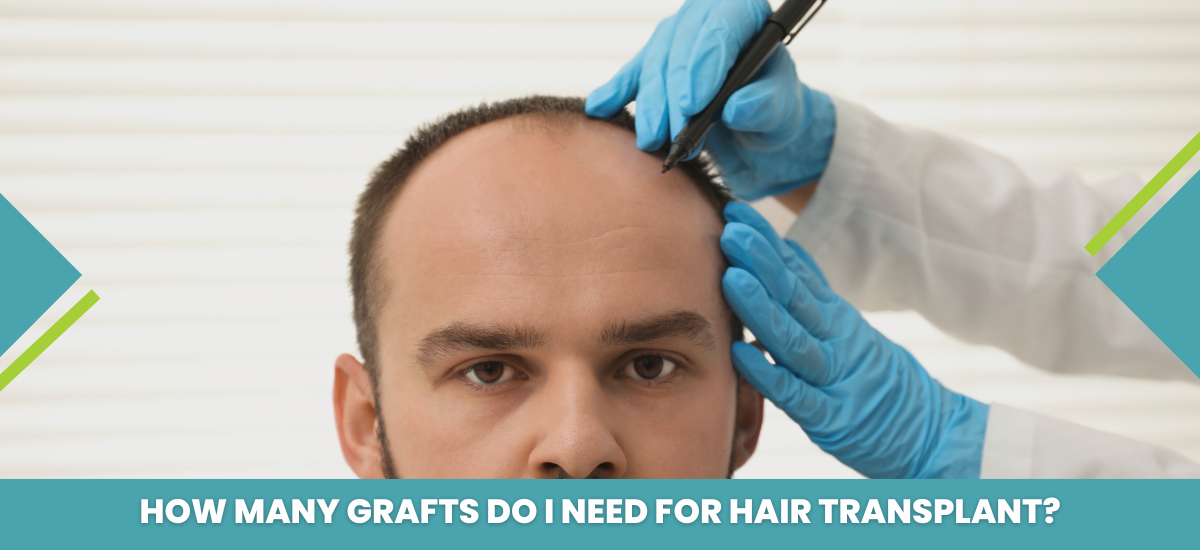
One of the first questions people ask before booking a hair transplant consultation is: “How many grafts will I need?”
It is a fair question. The graft count directly affects the procedure time, the result, and the cost. And yet, there is no single answer that fits everyone.
Dr. Deepesh Goyal, a trusted plastic surgeon in Jaipur at Rejuvena Cosmo Care, explains, “The number of grafts needed depends on your pattern of hair loss, your donor hair density, the technique we use, and the kind of result you want. It is not a one-size-fits-all number.”
So, let us break this down clearly, so you know exactly what to expect before you walk into the clinic.
What Is a Graft? (And Why It Matters)

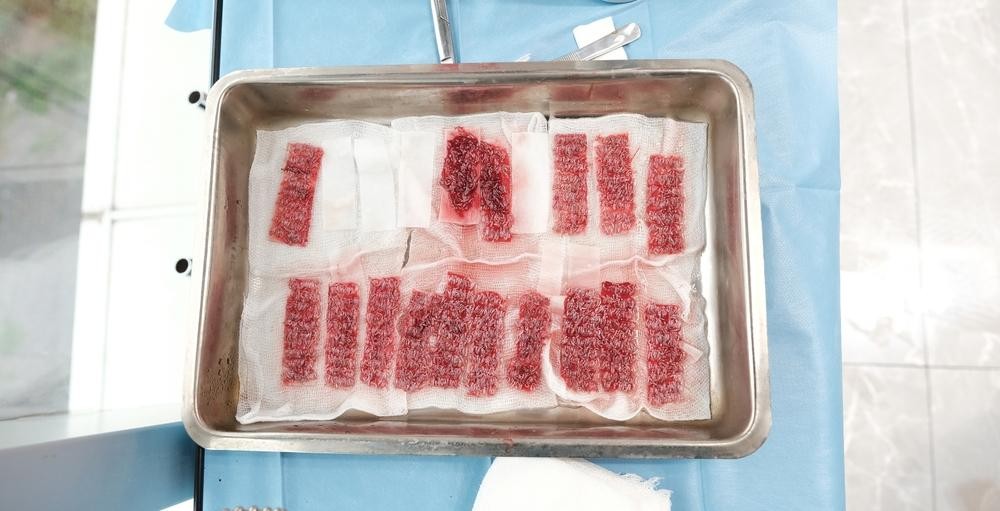
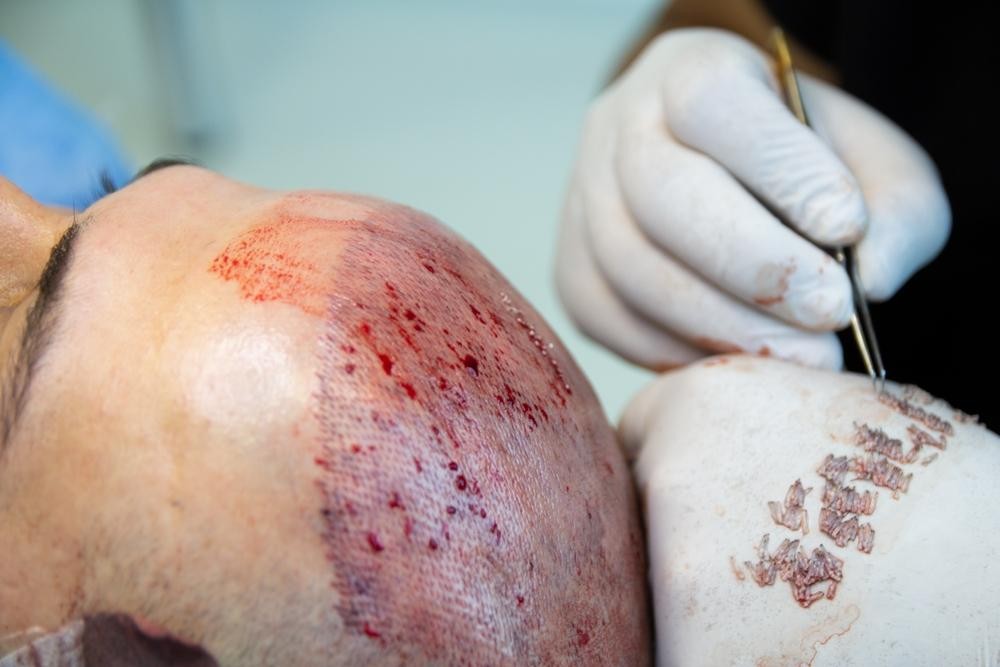
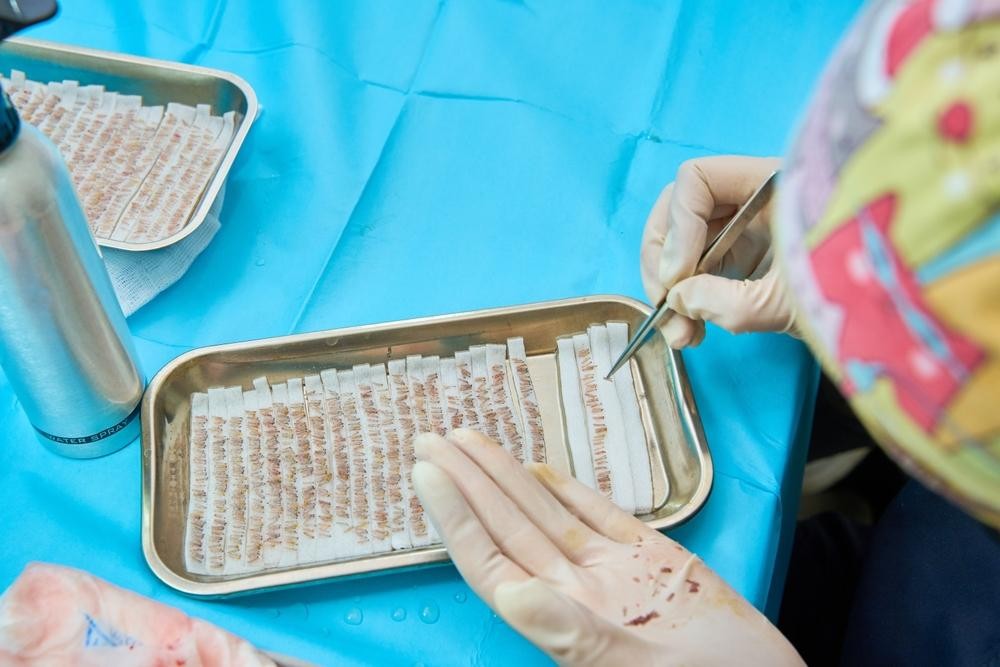
Graft Sorting Process During Hair Transplant Surgery
Before we talk numbers, let us understand what a graft actually is.
A graft is a tiny unit of tissue that holds one or more hair follicles. During a hair transplant, the surgeon takes these grafts from a donor area, usually the back or sides of your scalp, and places them into the thinning or bald zones.
Each graft can carry a different number of hairs:
- 1 hair – used along the hairline for a soft, natural edge
- 2 to 3 hairs – placed just behind the hairline to build gradual density
- 3 to 4 hairs – used in the crown and central zone for fuller coverage
Graft Sorting Process During Hair Transplant Surgery
So when someone says “2000 grafts,” they do not mean 2000 individual hairs. Depending on the follicular grouping, 2000 grafts can actually give you anywhere between 4000 to 7000 hairs. This is why the hair-to-graft ratio matters just as much as the graft count itself.
The way grafts are sorted and placed also determines how natural your result looks. A skilled surgeon distributes single-hair grafts at the front, and denser multi-hair grafts toward the back and crown. This gradual buildup is what gives a transplant a completely natural appearance, with no “pluggy” or patchy look.
“Patients often confuse grafts with individual hair strands. In reality, a single graft can carry two to four hairs. This is why a procedure of 2000 grafts can give you significantly more coverage than you might expect.”
– Dr. Deepesh Goyal, Plastic Surgeon, Rejuvena Cosmo Care, Jaipur
How Many Grafts Do You Actually Need?
This depends on your stage of hair loss. The most widely used scale to measure hair loss in men is the Norwood Scale, which goes from Stage 1 (minimal loss) to Stage 7 (complete baldness on the crown and top).
Here is a quick reference:
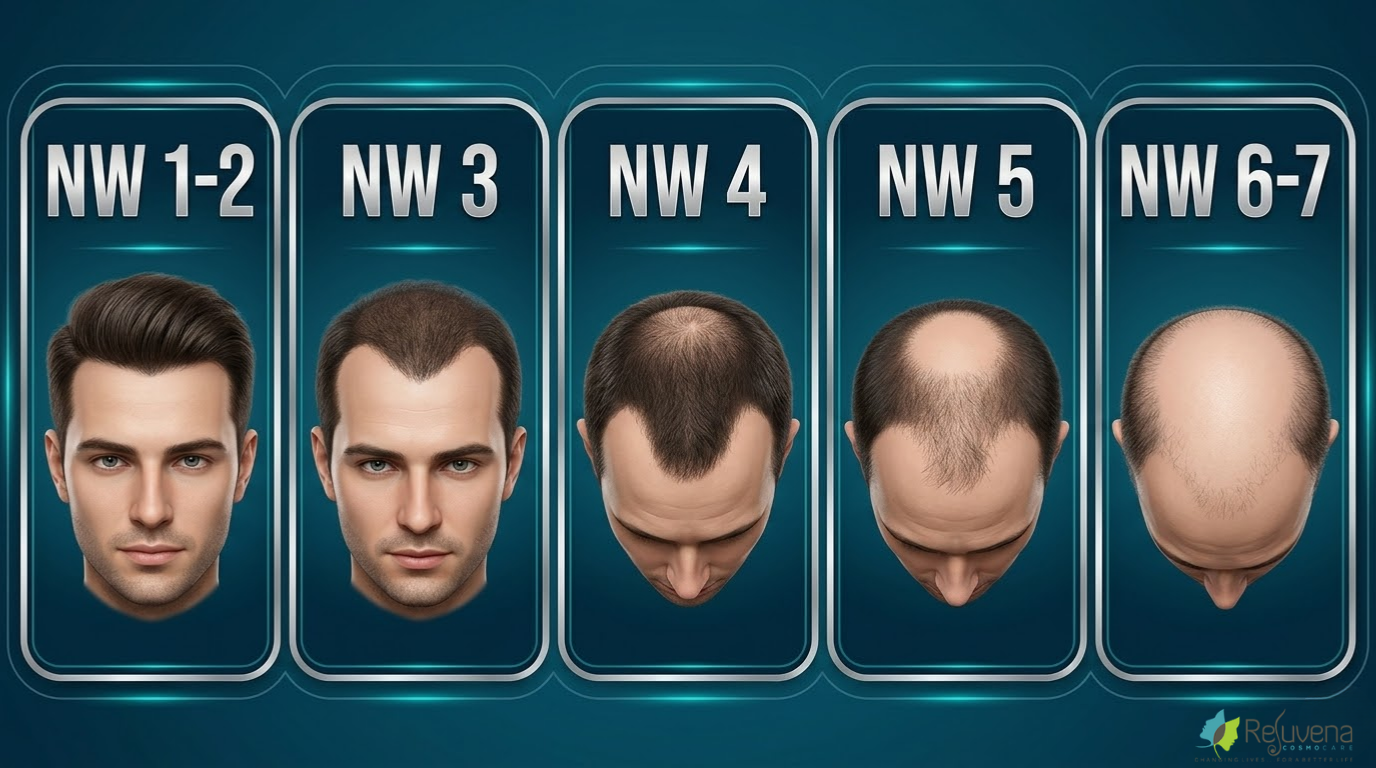
Norwood Scale Hair Loss Stages Illustration
Hair Transplant Graft Count by Norwood Stage
Understanding the full growth timeline helps set the right expectations. Here is a simple overview:
|
Norwood Stage |
Hair Loss Pattern |
Estimated Grafts Needed |
|
Stage 1 |
Minimal or no hair loss |
Not required |
|
Stage 2 |
Slight recession at temples |
500 – 1000 grafts |
|
Stage 3 |
Deeper recession at temples |
1000 – 1500 grafts |
|
Stage 3 Vertex |
Thinning on the crown begins |
1500 – 2000 grafts |
|
Stage 4 |
Significant thinning on crown and temples |
2000 – 2500 grafts |
|
Stage 5 |
Crown and front merge, wide bald area |
2500 – 3500 grafts |
|
Stage 6 |
Large bald zone across top of scalp |
3500 – 4500 grafts |
|
Stage 7 |
Only a band of hair remains at the back |
5000 – 7000 grafts |
Note: These are general estimates. Your actual graft requirement will be determined after a physical assessment by the surgeon.
For women, the Ludwig Scale is used. Female hair loss is usually diffuse (spread across the scalp rather than in patches), so the approach and graft count differ. If you are considering a female hair transplant in Jaipur, you should know that women typically need anywhere from 1000 to 3000 grafts depending on the extent of thinning.
How Many Grafts Do You Need by Coverage Area?
This is one of the most common queries people search for, and for good reason. A session of 2000 grafts is one of the most frequently recommended counts at clinics across India, including at Rejuvena Cosmo Care in Jaipur.
Here is what 2000 grafts typically covers:
- Hairline restoration for Stage 3 or Stage 4 hair loss
- Front and mid-scalp coverage in men with moderate thinning
- Crown coverage in early stages of vertex thinning
If your hair loss is at Norwood Stage 5 or beyond, 2000 grafts may not be enough to give you a full result. In those cases, a higher graft count or a staged approach (two sessions over time) may be recommended.
A “full head” transplant – covering everything from the hairline to the crown – requires significantly more grafts. For advanced stages of hair loss (Stage 6 and 7), you are typically looking at 5000 to 7000 grafts.
However, this is subject to donor availability. If your donor area does not have enough follicles to support such a large session safely, the surgeon will plan a staged approach.
“Overharvesting the donor area to chase a higher graft count is something I never recommend. A natural result with a healthy donor area is always better than an aggressive extraction that leaves the back of your head looking thin.”
– Dr. Deepesh Goyal, Plastic Surgeon, Rejuvena Cosmo Care, Jaipur
What Factors Decide How Many Grafts You Need?
Your graft count is not just about how bald you are. Several factors influence the number your surgeon will recommend.
The Extent of Hair Loss
This is the most obvious factor. The larger the area that needs coverage, the more grafts are required.
Donor Hair Density
Some people naturally have dense, thick hair in the donor zone (back and sides of the scalp). Others have a thinner donor area. A denser donor area means more grafts can be safely extracted.
Hair Texture and Curl
Curly or wavy hair provides better visual coverage with fewer grafts. Straight, fine hair may require more grafts to achieve the same look.
Desired Density
Do you want a natural-looking hairline, or do you want maximum density? The answer changes the graft count. Higher density needs more grafts per square centimetre.
Technique Used
The technique also matters. Here is how the three main techniques compare:
|
Technique |
How Grafts Are Extracted |
Max Grafts Per Session |
Scarring |
|
Individual follicles, one by one |
Up to 3500 – 4000 |
Tiny dot scars (mostly invisible) |
|
|
Strip of scalp removed and dissected |
Up to 4000 – 5000 |
Linear scar at the back |
|
|
Similar to FUE, grafts implanted directly |
Up to 3500 |
Minimal |
At Rejuvena Cosmo Care in Jaipur, Dr. Deepesh Goyal performs FUE, FUT, and DHT – and guides each patient toward the technique best suited to their specific needs.
Hair Transplant Graft Cost in Jaipur - What to Expect
Now, the question everyone has in the back of their mind: what does it cost?
Hair transplant cost in Jaipur is typically calculated per graft. Here is a general range:
|
Number of Grafts |
Approximate Cost in Jaipur |
|
1000 grafts |
Rs. 30,000 – Rs. 50,000 |
|
2000 grafts |
Rs. 60,000 – Rs. 1,00,000 |
|
3000 grafts |
Rs. 90,000 – Rs. 1,50,000 |
|
4000 grafts |
Rs. 1,20,000 – Rs. 2,00,000 |
|
5000+ grafts |
Rs. 1,50,000 – Rs. 2,50,000+ |
For a precise cost estimate based on your graft count, book a consultation with Dr. Deepesh Goyal at Rejuvena Cosmo Care, Jaipur.
Not sure about your graft count? Consult Dr. Deepesh Goyal today.
Is There a Graft Calculator for Hair Transplant?
Many people search for an online graft calculator before visiting a clinic. These tools can give a very rough idea, but they are not reliable. A proper graft count depends on your bald area size, donor density, hair texture, and long-term hair loss pattern – none of which an online tool can assess accurately.
As a general reference, surgeons typically recommend 40 to 60 grafts per square centimetre for good density. So if your bald area is around 80 sq cm, you could need anywhere between 3200 to 4800 grafts.
The only way to get an accurate number is through a clinical assessment with Dr. Deepesh Goyal at Rejuvena Cosmo Care, Jaipur.
What Happens If Fewer Grafts Are Used Than Needed?
This is something that happens more often than it should, especially when patients choose clinics based on cost alone.
If too few grafts are placed:
- The coverage looks thin and unnatural
- Patches may appear between transplanted and non-transplanted zones
- You may need a second session to fix the gaps
- The result may not match your expectations at all
Dr. Deepesh Goyal advises patients to prioritise a thorough consultation over a low upfront price. Getting the graft count right the first time saves both money and stress in the long run.
“In my experience, most cases of unsatisfactory hair transplant results come from two things – choosing the wrong surgeon or getting too few grafts to cover the area properly. A detailed pre-surgery assessment prevents both.”
– Dr. Deepesh Goyal, Plastic Surgeon, Rejuvena Cosmo Care, Jaipur
Before and After - What Real Results Look Like at Different Graft Counts
See more real patient results in our Hair Transplant Before and After Gallery.
Wondering if you are a candidate? Let the expert decide.
Key Takeaways - Hair Transplant Graft Count at a Glance
Here is a quick summary of everything covered above:
- A graft contains 1 to 4 hair follicles – it is not the same as a single strand of hair
- Your graft requirement depends on your Norwood stage, donor density, hair texture, and desired coverage
- 2000 grafts suits Norwood Stage 3 to 4; advanced stages may need 5000 grafts or more
- FUE, FUT, and DHT differ in how many grafts can be safely extracted per session
- In Jaipur, hair transplant costs are calculated per graft and vary by clinic and technique
- Always get a clinical assessment – do not rely on online graft calculators alone
Ready to find out your exact graft count? Visit Rejuvena Cosmo Care, Jaipur
Frequently Asked Questions
How many grafts do I need for a hairline transplant only?
For a hairline-only transplant (front zone, no crown), you typically need between 1000 and 2000 grafts, depending on how receded your hairline is and how dense you want it to look.
Can I get 5000 grafts in a single session?
It depends on your donor availability and the technique. FUT can sometimes yield up to 4000–5000 grafts in one session. FUE is usually capped at 3500 to 4000 per session to protect the donor area. If you need more, two sessions spaced a few months apart may be recommended.
How long does a 2000-graft hair transplant take?
A session of 2000 grafts usually takes between 6 to 8 hours. Larger sessions of 3500 to 5000 grafts may take 10 to 12 hours and are sometimes split over two days.
Will I need a second hair transplant after the first one?
If your hair loss is at an early stage (Norwood 3 or 4) and your loss is stable, one session may be enough. However, if hair loss is progressive or if you have advanced baldness (Stage 6 or 7), a staged approach with more than one session is often planned from the beginning.
Does a higher graft count always mean better results?
Not necessarily. Placing too many grafts in too small an area can look unnatural and may also damage existing hair. The right graft count – matched to your area and donor capacity – gives the best, most natural result. This is why a proper surgical plan matters more than simply going for the highest number.
References
- International Society of Hair Restoration Surgery (ISHRS) – Hair Transplant Graft Calculations and FUE Guidelines https://ishrs.org/patients/treatments/
- National Library of Medicine – Follicular Unit Transplantation and Follicular Unit Extraction: A Comparison https://pubmed.ncbi.nlm.nih.gov/
- American Academy of Dermatology – Hair Loss: Who Gets It and Why https://www.aad.org/public/diseases/hair-loss/types/alopecia
Disclaimer: The information shared in this content is for educational purposes only and not for promotional use.