
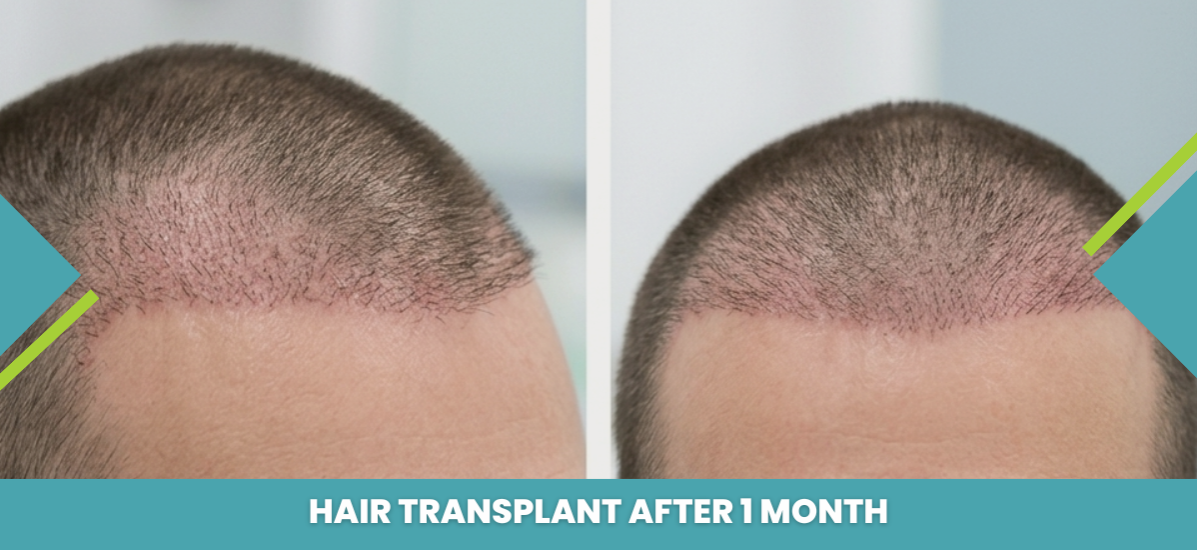
You had your hair transplant four weeks ago. And now, looking in the mirror, you wonder – why does my scalp look sparse? Why is the hair falling out? Did something go wrong?
The answer, in most cases, is no. Nothing went wrong.
The one-month mark after a hair transplant is one of the most misunderstood phases of the entire journey. Most patients feel confused or even panicked – and they reach out to their surgeon worried that the procedure has failed.
At Rejuvena Cosmo Care, Dr. Deepesh Goyal, a trusted plastic surgeon in Jaipur regularly reassures patients that what they see at one month is completely expected. In fact, it is a sign that the healing process is right on track.
This blog will walk you through everything you should know about hair transplant recovery at the one-month mark – from shedding to scalp care to what comes next.
Is It Normal to Have No Hair Growth at 1 Month?
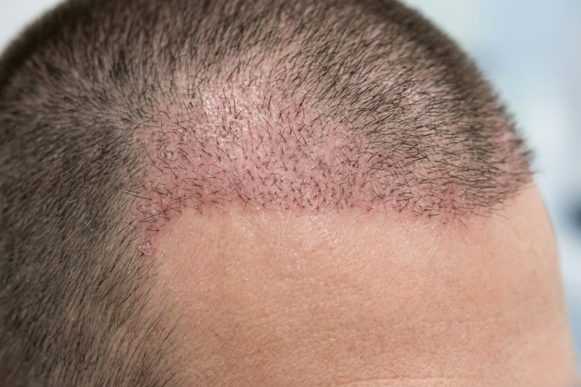
Yes, absolutely.
At one month, you will not see new hair growth. This is biologically normal and has nothing to do with the success of your procedure.
Here is why. After a hair transplant, the transplanted follicles go through a resting phase called telogen. During this phase, the hair shaft falls out but the root remains safely anchored beneath the scalp. The follicle is very much alive – it is just resting before it begins producing new hair.
New visible growth typically starts between months 3 and 4. So at month 1, you are still early in the process.
“One month post-transplant is probably the most anxious time for patients. They see shedding and assume failure. But I always tell them – the root is alive, it is just resting. Trust the biology.”
– Dr. Deepesh Goyal, Plastic and Cosmetic Surgeon, Jaipur
Why Does Hair Fall Out at 1 Month After Transplant?
This is the most common concern at this stage. The shedding you see is called shock loss or post-transplant effluvium.
This is especially common after FUE hair transplants, where individual follicles are extracted and implanted one by one. Here is what happens at a cellular level:
- During the transplant, follicles are moved from the donor area to the recipient area
- This temporary trauma puts the hair growth cycle into a resting state
- The hair shaft, which is no longer receiving active growth signals, naturally detaches and falls out
- The follicle remains intact beneath the scalp and re-enters the growth phase on its own timeline
Shedding usually begins between weeks 2 and 6. By month 1, many patients are experiencing peak shedding or have already crossed it.
“Shock loss looks alarming but it is part of normal follicle biology. The hair shaft sheds, but the follicle that produces it is still alive and working. Growth will follow.”
– Dr. Deepesh Goyal, Rejuvena Cosmo Care, Jaipur
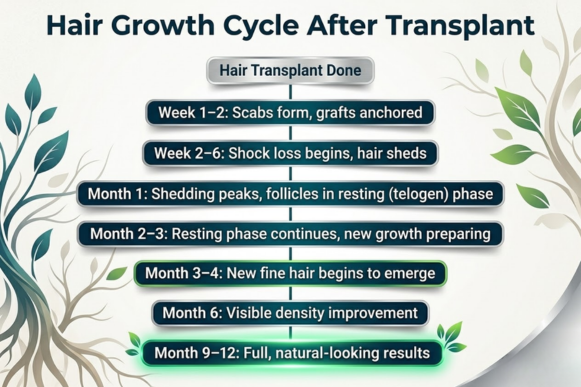
Month-by-Month Hair Transplant Growth Timeline
Understanding the full growth timeline helps set the right expectations. Here is a simple overview:
| Month | What to Expect |
| Month 1 | Shedding of transplanted hair shafts, scalp looks sparse, follicles resting |
| Month 2 | Continued resting phase, scalp starts to settle, minimal visible change |
| Month 3 | Early new growth begins, fine and light-coloured hair starts appearing |
| Month 4 to 5 | More noticeable growth, hair becomes slightly thicker |
| Month 6 | Visible density improvement, significant change from the 1-month stage |
| Month 9 | Hair texture and thickness improve considerably |
| Month 12 | Final results visible, natural-looking density achieved |
Most patients see their final results between 10 and 14 months after the procedure. Results may vary based on individual healing, graft count, and the technique used.
For a detailed week-by-week breakdown, read our blog on FUE Recovery Timeline.
What Can You Do at 1 Month After Hair Transplant?
By the one-month mark, most patients feel physically normal. Recovery restrictions are largely lifted. However, some precautions still apply.
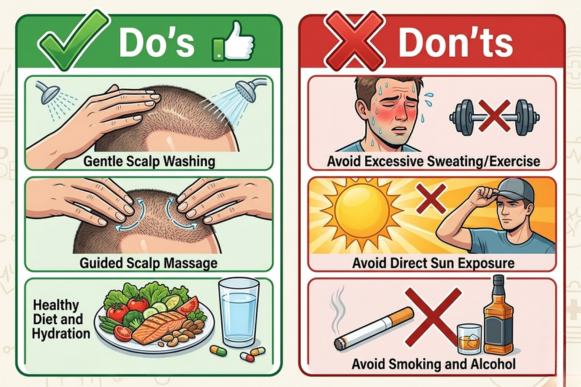
What you can do:
Wash your hair normally with a mild shampoo
Return to desk work and light daily activities
Travel comfortably
Sleep in a normal position without elevation
Go outdoors, but protect the scalp from direct sun
What you should still avoid:
Contact sports
Swimming in chlorinated pools or the sea
Smoking and alcohol, which can slow healing
Heavy gym workouts and weight lifting (typically cleared at 4 to 6 weeks based on your surgeon
Prolonged sun exposure without a hat or sunscreen
Signs that your recovery is going well at this stage:
- Scabs have fully cleared (usually by day 10 to 14)
- Donor area at the back feels smooth and comfortable
- Scalp looks clean with no active wounds or infections
- Shedding is occurring but there is no pain or discharge
- No unusual swelling beyond the first few days
If your scalp matches this description and you are following the above guidelines, you are healing well.
“By month one, patients feel great and want to jump back into their full routine. I encourage that – but with some boundaries still in place. The follicles are still in a sensitive transition stage.”
– Dr. Deepesh Goyal, Jaipur
Ready to know if your recovery is on track? Book a follow-up consultation with Dr. Deepesh Goyal at Rejuvena Cosmo Care, Jaipur.
Hair Care Routine at 1 Month
By this stage, you can follow a gentle but more normal hair care routine. Here are some tips:
Washing
Use a mild, sulphate-free shampoo
Wash gently with fingertips, no rubbing or scrubbing
Rinse with lukewarm water, not hot
Moisturising the Scalp
Apply any prescribed lotion or oil as directed
Rinse with lukewarm water, not hot
Avoid strong chemical products or hair dyes for at least 3 months
Sun Protection
Wear a loose, breathable hat or cap when going outside
Apply sunscreen to the scalp if you are heading out without a cap
Prolonged UV exposure can affect healing and graft quality
Medications
Continue prescribed medications like minoxidil or finasteride if recommended
Do not stop any hair-related medication without consulting your surgeon
Some patients also begin supplementary PRP treatment at the one-month mark to stimulate follicle activity and support faster growth – ask your surgeon if this is suitable for you.
Warning Signs You Should Not Ignore at 1 Month
While most concerns at this stage are harmless, some signs do require attention. Contact your surgeon if you notice:
- Active infection with pus or severe redness
- Persistent swelling beyond 3 to 4 weeks
- Unusual pain or tenderness at the recipient site
- Grafts that appear to be entirely absent (not just shed shafts)
- High fever or flu-like symptoms alongside scalp symptoms
These are uncommon, but it is always better to check early.
Still unsure what stage your recovery is at? Let Dr. Deepesh Goyal review your progress and give you a personalised update.
Conclusion
The first month after a hair transplant can feel like a long wait with very little visible reward. But this is actually one of the most important phases of your entire hair restoration journey.
The follicles are resting, healing, and preparing. Shedding is not failure. Sparse appearance is not permanent. This is the quiet before the growth.
At Rejuvena Cosmo Care, Jaipur, Dr. Deepesh Goyal and his team ensure every patient understands their recovery clearly at every stage. From the day of the procedure to the final result, you are guided every step of the way.
If you are past your one-month mark and want to know what comes next – or if you are still in the planning stage – our clinic is here to answer every question.
Not sure what to expect next month? Read our guide on the full Hair Transplant Recovery Timeline or book a consultation with Dr. Deepesh Goyal today.
Frequently Asked Questions
1. Is it normal to see no new hair at 1 month after hair transplant?
Yes, it is completely normal. New hair growth typically begins between months 3 and 4. At month 1, follicles are in a resting phase after the transplant.
2. Why is my hair falling out 1 month after hair transplant?
This is called shock loss or post-transplant shedding. The hair shaft falls, but the root stays intact under the scalp and will produce new hair in the coming months.
3. How much shedding is normal at 1 month?
Most of the transplanted hair sheds between weeks 2 and 6. Shedding of nearly all transplanted hair shafts by month 1 is considered normal.
4. Can I go to the gym 1 month after hair transplant?
Light activities are generally fine. Heavy lifting and intense workouts are usually cleared between 4 to 6 weeks, depending on your surgeon’s specific advice.
5. When will I see the final results of my hair transplant?
Most patients see significant growth by month 6 and final results by 10 to 14 months after the procedure.
References:
- International Society of Hair Restoration Surgery – https://www.ishrs-htforum.org
- American Academy of Dermatology – https://www.aad.org/public/diseases/hair-loss/treatment/transplants
- National Library of Medicine – Hair Transplantation:https://www.ncbi.nlm.nih.gov/books/NBK547740/
Disclaimer: The information shared in this content is for educational purposes only and not for promotional use.
